

TL;DR:
- Accurate body measurements and understanding fit descriptions are essential to reducing online fashion returns.
- Research reviews and size charts thoroughly, especially focusing on customer data, for better fit predictions.
Ordering a trendy outfit online, only to receive something that fits nothing like the photos, is one of the most common frustrations in modern shopping. Apparel return rates are globally high, with size and fit discrepancies driving the majority of those returns. The good news: a structured, stepwise approach to online fashion shopping dramatically cuts that risk. This guide walks through every stage, from taking measurements to completing checkout, so you can shop with confidence and keep more of what you order.
Table of Contents
- Get your measurements and sizing tools ready
- Research product fit signals beyond the size tag
- Shortlist with confidence: Tactics to reduce return risk
- Make the purchase: Price, process, peace of mind
- When between sizes or using advanced tools: Special case strategies
- A smarter shopper’s perspective: Why fit, not price, is your first filter
- Discover smarter fashion shopping with ZINGS 365
- Frequently asked questions
Key Takeaways
| Point | Details |
|---|---|
| Measure before buying | Use current body measurements and match them with each brand’s size chart for the best fit. |
| Decode fit clues | Read product details and user reviews, not just size tags, to predict how items will fit you. |
| Shortlist smartly | Only add items to your cart if they have clear sizing confidence and return-friendly policies. |
| Embrace sizing tech | Leverage new tools like virtual fitting and interactive guides for even better outcomes. |
| Prioritize fit over price | A wardrobe that fits reduces returns and frustration—saving money in the long run. |
Get your measurements and sizing tools ready
Preparation is the foundation of every successful online fashion purchase. Most shoppers skip this step and rely on memory or guesswork, which is exactly why so many packages get sent back.
Why measurements matter more than size labels
A size “M” at one brand can be a size “L” at another. Standard size labels are not universal. They shift between countries, manufacturers, and even product lines within the same store. Your actual body measurements, in inches or centimeters, are the only consistent reference point you have.
Tools you need before you start
- A flexible measuring tape (fabric, not metal)
- A notepad or a dedicated app to log your numbers
- A full-length mirror or a friend to help with accuracy
- Access to each brand’s specific size chart
How to measure correctly
| Body area | Where to measure | Tips for accuracy |
|---|---|---|
| Bust/Chest | Fullest part of the chest | Keep tape parallel to the floor |
| Waist | Narrowest part of the torso | Measure after exhaling naturally |
| Hips | Widest part below the waist | Stand with feet together |
| Inseam | Crotch to ankle bone | Use a pair of well-fitting pants |
| Shoulders | Shoulder point to shoulder point | Across the upper back |
According to brand-specific size charts, you should always measure your body using the same method the chart assumes. For example, if a chart lists chest measurements taken over a fitted shirt, replicate that condition exactly.
Matching your numbers to the right chart section matters just as much as the measurement itself. Many shoppers measure correctly but then read the wrong column, picking a size meant for a different fit style. Always cross-reference at least two measurements before confirming a size.
For items like size tips for oversized T-shirts, the sizing logic shifts. Oversized styles are intentionally cut larger, so you may need to size down from your usual selection.
Pro Tip: Log your measurements in a notes app and update them every season or whenever your body changes. Having your numbers ready saves time and reduces the temptation to guess.
Research product fit signals beyond the size tag
Once you have your numbers, it is not as simple as matching a label. The next step is decoding what each item’s data reveals about actual fit.

Reading fit descriptions
Product pages use specific language that carries real meaning. Terms like “slim fit” indicate a closer cut through the chest and thighs. “Relaxed fit” means extra room throughout. “Stretch fabric” signals flexibility that accommodates a wider range of body types. Pay attention to fabric composition too. A fabric with 5% or more elastane will behave very differently from 100% cotton.
Model measurements and review data
Most product pages list the model’s height and the size they are wearing. Use this as a reference point, not a rule. If the model is 5’10" wearing a size S and you are 5’5", the proportions will look different on you.
Studies show that shoppers who rely on fit-related review data and garment measurement details make significantly fewer size errors than those who rely on labeled sizes alone.
Customer reviews are one of the most underused tools in online fashion shopping. Look specifically for reviewers who share their height, weight, and measurements alongside their size choice. That combination of data gives you a realistic picture of how the item performs on a real body, not a sample model.
Comparison: ways to judge fit before buying
| Method | Accuracy | Effort needed | Best for |
|---|---|---|---|
| Size label only | Low | None | Never recommended |
| Brand size chart | Medium | Low | Starting point |
| Fit description | Medium-High | Low | Cut and style decisions |
| Customer reviews | High | Medium | Real-world fit confirmation |
| User photos in reviews | Very High | Medium | Proportion and drape |
For items like fit selection for stretch pants, reviews that mention thigh and hip fit are especially useful, since stretch fabrics can accommodate more variation but still have limits.
Pro Tip: Filter reviews by shoppers who list their measurements. A review that says “I am 5’6”, 145 lbs, 36" hips, ordered a size M and it fits perfectly" is worth ten generic five-star ratings.
Shortlist with confidence: Tactics to reduce return risk
Being a smart shopper means not just finding what you want, but filtering by how likely it is to actually work for you and your wallet.
Steps to build a confident shortlist
- Confirm your measurements match the size chart for each item on your list.
- Read the fit description and note whether the cut suits your body type.
- Check at least five to ten customer reviews, prioritizing those with measurement data.
- Review the return policy before adding anything to your cart.
- Rank your shortlist by confidence in fit, not by price or visual appeal alone.
The bracketing method
Bracketing means ordering two sizes of the same item with the intention of returning one. It works, but only under specific conditions. Apparel return rates are already high globally, with over half of returns driven by fit issues. Bracketing adds to that volume unless returns are genuinely free and simple.
Use bracketing selectively. It is most useful when you are genuinely between two sizes and the retailer offers free, label-included return shipping with no restocking fee.
Technology tools
Interactive size guides are becoming more common on fashion sites. These tools ask for your measurements and body shape details, then recommend a size based on the item’s specific cut. They are not perfect, but they add a layer of data that a static chart cannot provide.
For confidence in size selection, combining a size guide with review data gives you the strongest possible foundation before committing to a purchase.
Pro Tip: Sort your shortlist by highest confidence in fit, not by lowest price. Buying the wrong size at a discount still costs you time and hassle.
Make the purchase: Price, process, peace of mind
Narrowing down your picks means you are almost there. Here is how to seal the deal and avoid any last-minute pitfalls.
Final verification checklist before checkout
- Confirm your size matches the chart for this specific item, not just the brand in general
- Double-check the color and style shown match what you want
- Verify the price matches what you saw when you first viewed the item
- Screenshot the product page, price, and return policy before completing payment
- Use a secure payment method with buyer protection
- Save your order confirmation email immediately
Using price history tools
Fashion prices shift constantly. A jacket listed at $79 today may have been $55 two weeks ago. Understanding price trends before you buy helps you avoid paying inflated prices during manufactured “sale” events.
Price verification methods compared
| Method | What it does | Best for |
|---|---|---|
| Price history browser extension | Tracks price changes over time | Spotting fake discounts |
| Wishlist monitoring | Alerts when saved items drop | Passive deal tracking |
| Seasonal timing | Buying off-season for lower prices | Planned, non-urgent purchases |
| Coupon aggregator sites | Finds active promo codes | Immediate savings at checkout |
A research-first shopping funnel means you plan, validate, and shortlist with cost and policies in mind before you ever click “buy.” This approach consistently produces better outcomes than impulse purchasing, even when the impulse item looks perfect.
After purchase, confirm your estimated delivery window and note the return initiation deadline. Most online retailers require returns to be started within 14 to 30 days of delivery. Missing that window means you are stuck with the item regardless of fit.
When between sizes or using advanced tools: Special case strategies
Even with the basics mastered, online fashion can throw you curveballs. These advanced strategies help you troubleshoot unusual challenges.
Navigating between sizes
Being between sizes is one of the most common dilemmas in online fashion. The best workaround is to follow chart measurement ranges, fit notes, and reviews rather than defaulting to the larger or smaller size automatically.
Ask yourself these questions:
- Does the fit description lean toward a generous or close cut?
- Do reviews say the item runs small or large?
- Which body area is most critical for comfort in this garment type?
For tops, prioritize shoulder and chest fit. For bottoms, prioritize hip and thigh fit. Waist and length can often be adjusted, but structural fit points cannot.
When to bracket and when not to
- Bracket when: Returns are free, prepaid, and simple; you are genuinely unsure between two sizes; the item is a high-value purchase
- Do not bracket when: Returns require self-paid shipping; the item is final sale; the size difference is less than one full size
Virtual fitting and AI size tools
Some retailers and apps offer interactive size recommendations or virtual fitting for better accuracy. These tools use your measurements and sometimes body shape inputs to predict which size will fit best for a specific garment. They are not flawless, but they reduce guesswork significantly.
For items like short sleeve T-shirts or graphic T-shirts, virtual sizing tools are particularly useful because T-shirt fit varies widely based on cut, fabric weight, and intended style.
For price tracking alongside size decisions, advanced price tracking tools let you monitor both availability and cost changes, so you can act when the right size and the right price align.
Pro Tip: Only bracket where you know returns are genuinely free and simple. Paying return shipping twice can easily cancel out any savings from a sale price.
A smarter shopper’s perspective: Why fit, not price, is your first filter
Most shoppers open an online fashion site and sort by price. It feels logical. Lower cost equals lower risk. But that reasoning is backwards.
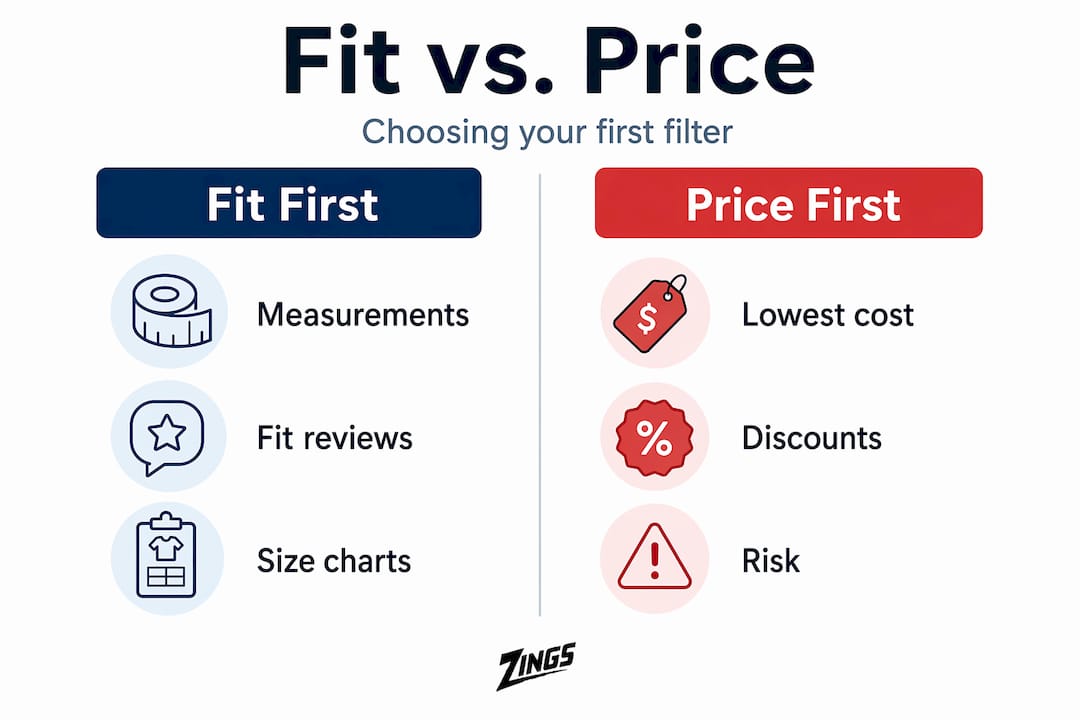
When price is your first filter, you are selecting from a pool of items without knowing whether any of them will fit. You then spend time evaluating style, reading reviews, and checking measurements, only to discover the best-fitting option was never in your filtered results. The process wastes time and often ends in a compromise purchase that gets returned anyway.
Shoppers who filter by fit first, starting with measurement compatibility and cut suitability, end up with a much smaller but far more reliable shortlist. Then price becomes a secondary sort within a set of items that are already likely to work. The result is fewer returns, less frustration, and a wardrobe that actually gets worn.
There is also a sustainability angle worth considering. Every returned garment travels back through a logistics chain that carries a real environmental cost. Buying right the first time is not just financially smarter. It is a more responsible way to shop.
The practical challenge is that fit-first filtering requires more upfront work. You need your measurements ready. You need to read size charts and fit descriptions before you browse. That investment of five to ten minutes per session pays back in time saved on returns, reorders, and the general frustration of clothes that do not work.
Try real-world size matching as your starting point for one full month. Filter by fit confidence first, then narrow by price. Compare your return rate to the previous month. The difference is usually significant enough to change your shopping habits permanently.
Discover smarter fashion shopping with ZINGS 365
Ready to put your new shopping strategy into practice? ZINGS 365 offers a broad range of affordable, stylish casualwear for men and women, with clear product descriptions and size guidance built into the shopping experience.
Browse customized men’s casual coats, casual sweatshirts, and hundreds of other pieces across the full ZINGS 365 collection. Each product page includes sizing details and customer feedback to help you apply everything covered in this guide. Flexible return options mean you can shop with confidence, not anxiety.
Frequently asked questions
How do I know which size to pick if I’m between two?
Check the brand’s size chart for measurement ranges, read fit notes, and use reviews mentioning body size. Bracketing works best for easy, free returns only.
Do all online shops use the same size standards?
No, sizes vary widely between brands. Always check each retailer’s brand-specific size chart and measurement guide before selecting.
What should I look for in reviews to help with sizing?
Look for reviews that mention height, weight, and measurements alongside the size ordered. Reviews with fit terminology like “runs small” or “true to size” are especially useful.
Are return policies standard across all online fashion sites?
No, return policies vary significantly. Read each site’s return policy before you buy, paying close attention to final sale items, return windows, and whether return shipping is covered.
How can I get better deals when online shopping for fashion?
Use price trend sites and price history browser extensions to identify the best times to buy. Tracking price history helps you spot genuine discounts versus inflated “sale” pricing.
