

TL;DR:
- Following fashion trends fulfills a deep-seated psychological need for social acceptance, reducing social anxiety and activating confidence.
- Using trends consciously as experiments within your personal aesthetic fosters authentic style, self-confidence, and mental well-being.
Fashion gets dismissed as shallow all the time. But the real reason why follow fashion trends matters goes much deeper than looking good. Research shows that social rejection is processed by the brain similarly to physical pain, which means staying current with style is partly a survival instinct. Understanding what actually drives trend behavior helps you make smarter choices about what you wear, why you wear it, and how to build a style that feels authentically yours.
Table of Contents
- Key Takeaways
- Why follow fashion trends: the psychology behind it
- How social media shapes trend adoption
- Balancing trend following with personal style
- Common challenges in following fashion trends
- How to use trends to boost confidence and connection
- My take on following trends consciously
- Build a wardrobe that works with trends, not against them
- FAQ
Key Takeaways
| Point | Details |
|---|---|
| Trends serve a psychological need | Following fashion reduces social anxiety by helping you fit in and feel accepted by your peers. |
| Social media accelerates trend cycles | Algorithms on Instagram and TikTok compress discovery timelines, making trends spread within days instead of seasons. |
| Most people want durability over hype | Over 80% of urban youth prefer clothing that lasts over chasing short-lived trends. |
| Trends work best as experiments | Use new trends to test ideas against your existing aesthetic rather than overhauling your wardrobe each season. |
| Fashion rules are often myths | Many conventional style rules are inaccurate and can limit creative self-expression rather than support it. |
Why follow fashion trends: the psychology behind it
The answer is rarely about vanity. Humans are wired for social connection, and clothing is one of the fastest signals the brain reads when assessing group membership. The bandwagon effect explains how adopting popular trends helps reduce the psychological pain of feeling left out. That pain is real. Neuroscience confirms that social exclusion activates the same brain regions as a physical injury.
This is not weakness. It is biology working exactly as intended.
Beyond belonging, what you wear shapes how you think and feel about yourself. Researchers call this “enclothed cognition.” When you put on something that feels current and intentional, your confidence shifts. You carry yourself differently. And that shift has measurable effects.
- Wearing trend-forward clothing improves mood and self-perception through enclothed cognition
- Feeling stylistically included reduces social anxiety before social situations
- Fashion satisfaction predicts about 19% of overall well-being, with a significant relationship between clothing choices and mental health outcomes
- Following trends consciously can serve as a mental health tool that builds confidence and cultural connection
“Fashion is not something that exists in dresses only. Fashion is in the sky, in the street; fashion has to do with ideas, the way we live, what is happening.” The point is that style has always been a form of social language. Knowing that language gives you power to communicate your identity without saying a word.
The key word above is consciously. The benefits kick in when you engage with trends on your own terms, not when you chase every new drop out of anxiety.
How social media shapes trend adoption
Instagram and TikTok did not just change where people discover fashion. They changed the speed at which trends live and die. Social media algorithms have collapsed the traditional runway-to-retail timeline into days, not months. A style moment spotted on a creator on Monday can be mass-produced and in carts by Friday.
This creates a specific dynamic for teenagers and young adults who are figuring out their style. The volume of trend content is enormous. And over 52% of global fashion shoppers use Instagram as their primary source of fashion inspiration, with 29% of US teens actively following fashion trends every single week.
Social learning theory explains why this is so effective. When you repeatedly see a style worn by people you admire or identify with, your brain registers it as normal and desirable. The aspiration loop activates. You want to replicate it.
Here is how to engage with social media for style without losing yourself in the scroll:
- Follow accounts that match your actual lifestyle, not just accounts that look aspirational. Style that works for a New York fashion week attendee rarely works for a school hallway.
- Save posts before buying anything. If you still love it two weeks later, it might be worth trying. Impulse saves are normal. Impulse purchases add up fast.
- Notice when you feel inspired versus when you feel inadequate. Both responses happen on the same platform. One is useful. The other is worth limiting.
- Diversify your feed intentionally. Following a range of styles gives you more material to build a personal aesthetic than following only one type of look.
Pro Tip: Use the “saved” folder on Instagram or TikTok as a personal mood board. After 30 days, look at what you saved and identify the common threads. That pattern is the beginning of your personal style.
Balancing trend following with personal style
This is where most people get it wrong. They treat trends and personal style as the same thing. They are not.
Trends are external signals. Personal style is your internal filter. The goal is to run trends through that filter, not replace the filter with every new season.
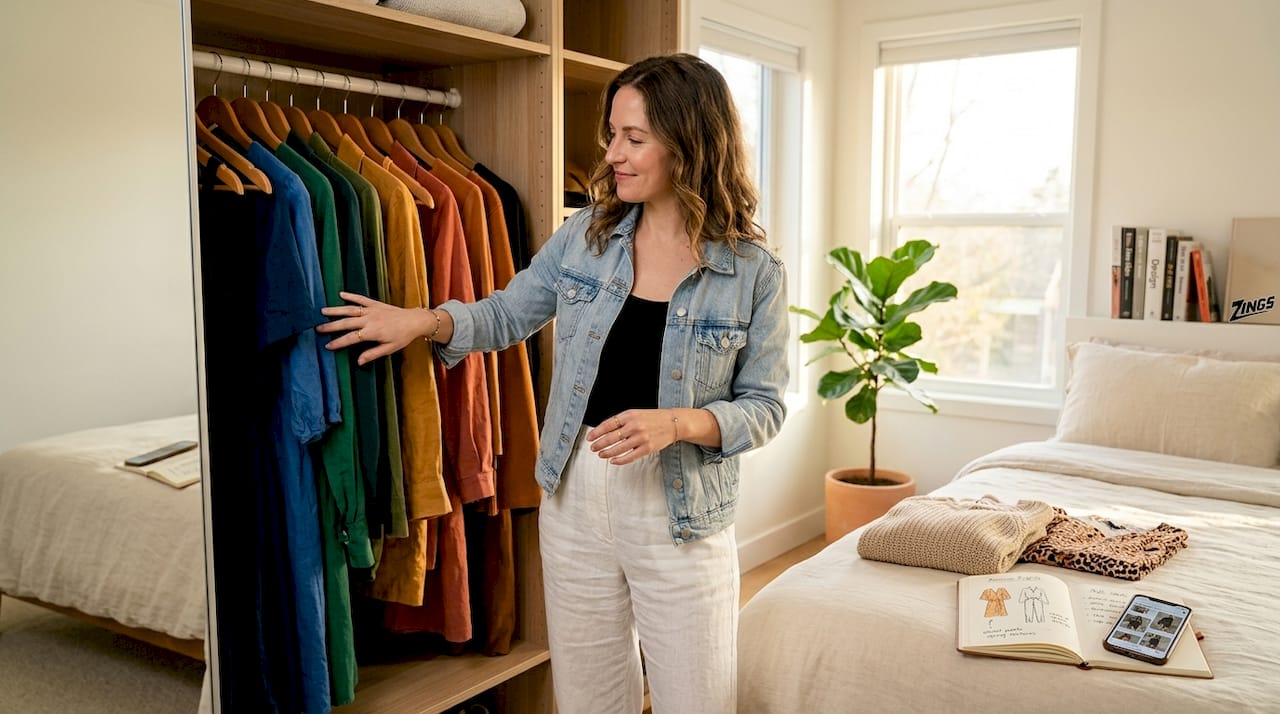
Stylish people do not follow trends blindly. They use new trends as experiments against their pre-established aesthetic. A new color palette that fits what they already love? Worth trying. A silhouette that conflicts with everything they own? Pass without guilt.
Research backs this up: consistent personal style builds stronger identity and confidence than constant reinvention. Structure and repetition are what create a recognizable look, not chasing novelty.
Here is a practical way to think about trend engagement:
| Approach | What it looks like | Long-term result |
|---|---|---|
| Passive trend following | Buying whatever is popular each season | Cluttered wardrobe, style inconsistency, overspending |
| Active personal style | Testing trends against your core aesthetic | Cohesive wardrobe, stronger self-image, fewer wasted purchases |
| Mindful curation | Investing in durable staples, adding trend pieces selectively | Cost-effective, sustainable, and genuinely personal |
A simple framework: build a core wardrobe of pieces that always work for you, then use trend items as additions rather than replacements. If you can shop trendy clothing without blowing your budget, you protect both your wallet and your style integrity.
Pro Tip: Before buying a trend piece, ask one question: does this work with at least three things I already own? If the answer is no, put it back. That rule alone will cut your wasted spending significantly.
Also worth noting: 82.7% of urban youth say they prioritize long-term durability over temporary fashion trends. You are not the only one thinking this way. The idea that everyone is racing to keep up with every trend is a myth amplified by social media, not reality.
Common challenges in following fashion trends
The biggest challenge is not the trends themselves. It is the pressure. Social media creates an environment where the pace of trend turnover makes it feel like you are always behind. That feeling is worth questioning.
Trend pressure can cause real anxiety, but awareness defuses most of it. When you recognize that you are feeling pressure to conform rather than genuine excitement about a style, you can make a more deliberate choice.
A few things worth knowing:
- Many conventional fashion rules are inaccurate. Horizontal stripes do not universally make people look larger. Rules about body types are mostly outdated guidelines that limit creativity without adding real value.
- There is a meaningful difference between passive trend following, which is buying what is popular without reflection, and active personal expression, which is using trends as a tool for identity.
- Fast fashion’s environmental cost is real. Clothing material choices matter both for sustainability and for how long a garment actually lasts.
- Economic pressure is also a factor. Buying into micro-trends that expire in three months is expensive. Knowing how to spot affordable trends before they peak saves money and reduces waste.
The goal is not to opt out of fashion entirely. The goal is to engage with it deliberately, so trends serve you rather than drain you.
How to use trends to boost confidence and connection
Trends are most useful when you treat them as tools rather than instructions.
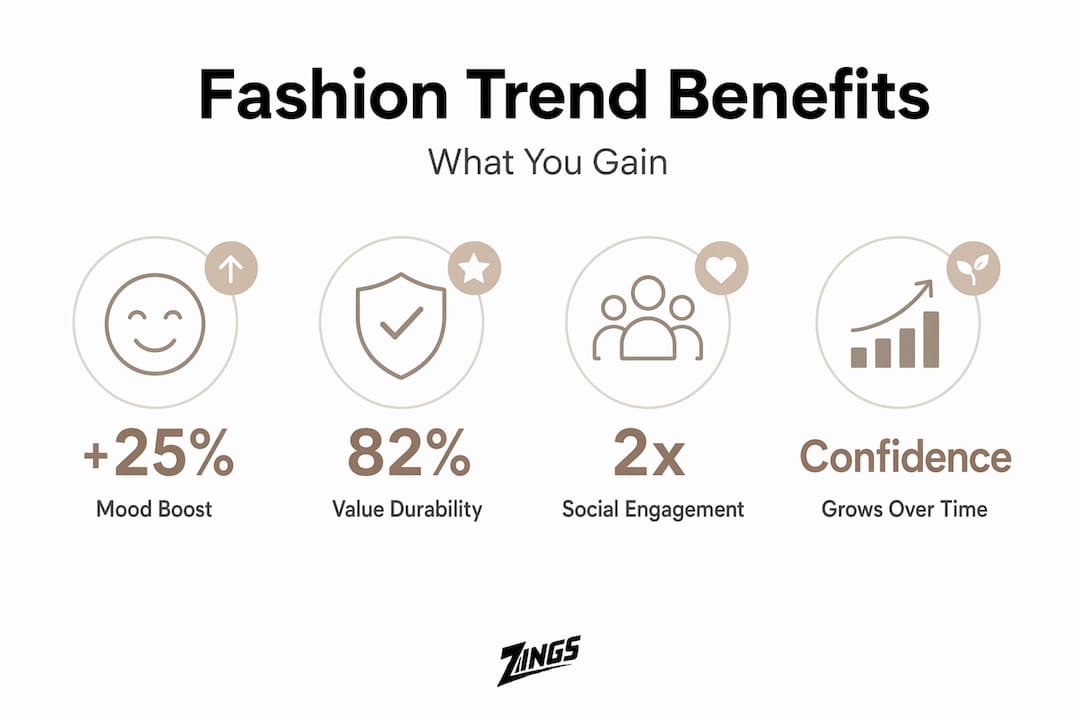
When you pick up a trend that fits your personality, it works as what some psychologists call “external armor.” You walk into a room knowing your outfit is a deliberate expression of who you are. That read as confidence by everyone else in the room.
Here is a practical approach to using trends this way:
- Identify two or three trends per season that genuinely interest you. Not every trend is for every person. Narrow the field before spending any money.
- Anchor trend pieces to your existing wardrobe staples. A trendy jacket worn over your regular jeans looks intentional. A full head-to-toe trend look can look like a costume.
- Build a small capsule of versatile basics. Once you have the foundation, a single trend piece does a lot of work without requiring a full wardrobe overhaul.
- Engage with social media on a schedule, not on reflex. Thirty focused minutes of style browsing is more productive than passively scrolling for hours. You get the inspiration without the comparison spiral.
Pro Tip: If you are working with a limited budget, building trendy outfits on a teen budget starts with investing in one or two quality basics and rotating a single trend piece through them. Versatility beats volume every time.
Fashion trends, used this way, stop being something that happens to you. They become something you use. That shift changes the entire experience.
My take on following trends consciously
I spent years chasing every trend that showed up in my feed, and I can tell you exactly where that leads. A wardrobe full of stuff that felt exciting for two weeks and irrelevant by the end of the month. More money spent than I care to calculate. And somehow, less confidence, not more.
What actually changed things was slowing down and being honest about what I consistently reached for. Those pieces were not the trend items. They were the reliable basics I had owned for years. Once I recognized that, I stopped treating trend following as a performance and started treating it as an occasional experiment.
Social media still influences me. I will not pretend it does not. But now I notice when a trend genuinely excites me versus when I am just responding to seeing it everywhere. That difference is everything. One leads to purchases I use. The other leads to purchases I regret.
My honest advice: spend more time understanding your own aesthetic than you spend scrolling through other people’s. The trends worth following are the ones that make something you already love look slightly more current. The rest are noise.
— TONY
Build a wardrobe that works with trends, not against them

At Zings365, the focus has always been on clothing that combines genuine style with everyday practicality. Whether you are building out a casual rotation or adding a few seasonal pieces, the catalog covers the key categories that matter: versatile tops, well-fitting jeans, and outerwear that actually holds up.
For men looking to add a trend-conscious layer without overcommitting, the men’s casual jacket is a reliable anchor piece that works across seasons. If you want a full casual set that balances comfort and current style, the hooded cardigan sports suit is a strong option. For a foundational wardrobe staple, the casual stretch trousers offer the fit and flexibility that makes daily dressing easier. Explore the full Zings365 collection to find pieces that fit your style, budget, and the way you actually live.
FAQ
Why do people follow fashion trends?
People follow fashion trends primarily for social belonging and personal confidence. The brain processes social rejection similarly to physical pain, which means wearing recognizable trends helps reduce anxiety in social settings.
What are the main benefits of following fashion?
The benefits of following fashion include improved mood through enclothed cognition, stronger social connection, and greater self-confidence. Research shows that fashion satisfaction predicts a meaningful portion of overall well-being.
Should you follow every new fashion trend?
No. Stylish people use trends as experiments against their existing personal aesthetic rather than replacing their wardrobe each season. Selective engagement produces better style outcomes and reduces unnecessary spending.
How does social media influence fashion trends?
Social media algorithms compress the time between trend discovery and mass adoption, often reducing it to days. Over half of global fashion shoppers use Instagram as their main inspiration source, which gives platforms enormous influence over what people wear.
How do you follow style trends without losing your personal identity?
Build a core wardrobe of pieces that consistently reflect your aesthetic, then add trend items selectively. If a trend piece does not work with at least three things you already own, it is unlikely to integrate into your actual style.
