

TL;DR:
- Smart casual is a balanced dress code that emphasizes neat, well-fitted, and cohesive attire without being overly formal. It allows for dark jeans, chinos, collared shirts, and clean sneakers, suited for many social and professional occasions. Focusing on minimal, versatile basics with intentionality ensures appropriate dressing while avoiding overcomplication.
You show up to a dinner event wearing a crisp blazer and tailored trousers, only to find everyone else in dark jeans and neat shirts. Or the opposite: you wear clean sneakers and chinos to what turns out to be a semi-formal gathering. Smart casual is one of the most misunderstood dress codes out there, and that confusion has real social consequences. This guide cuts through the noise, defines what smart casual actually means, and gives you a clear, practical framework for dressing right every time without spending a fortune.
Table of Contents
- What smart casual really means
- How to build a smart casual outfit: Key components
- Occasions to wear smart casual
- Smart casual vs. business casual (and common mistakes)
- Why most people overcomplicate smart casual—and how to keep it simple
- Shop smart casual essentials for every occasion
- Frequently asked questions
Key Takeaways
| Point | Details |
|---|---|
| Balanced approach | Smart casual is about mixing structured with relaxed pieces for a look that is intentional but not stiff. |
| Fit and fabric matter | Prioritize quality fit and clean materials for a polished appearance, even on a budget. |
| Occasion versatility | Smart casual is appropriate for a wide range of work and social events where traditional dress codes may be unclear. |
| Simple formulas work | Anchor your outfit with one elevated item and one casual element to stay comfortably smart. |
| Confidence counts | A confident, authentic approach to smart casual always elevates your overall look. |
What smart casual really means
Smart casual is not just “casual with a blazer thrown on top.” That common shortcut misses the point entirely. The dress code has specific characteristics that set it apart from both everyday casual wear and more formal professional attire.
As FashionBeans describes it, “smart casual is a dress code that aims to look neat and appropriate while still being relatively informal, positioned between casual and more formal business wear.” That positioning is the key. It occupies a deliberate middle ground.
Think of dress codes as a spectrum:
| Dress code | Examples | Formality level |
|---|---|---|
| Casual | T-shirts, sweatpants, athletic wear | Low |
| Smart casual | Dark jeans, chinos, collared shirts, clean sneakers | Medium |
| Business casual | Dress trousers, blazers, Oxford shirts | Medium-high |
| Formal / Black tie | Suits, tuxedos, evening gowns | High |
Smart casual sits at the medium level. It requires more intentionality than throwing on whatever is comfortable, but it does not demand the precision or cost of a full professional wardrobe. What separates it from everyday casual is a focus on:
- Fit: Clothes should fit well, not baggy or excessively tight
- Condition: Pieces must be clean, free of distress, fading, or obvious wear
- Cohesion: Items should look like they belong together
- Fabric: Choose materials that hold their shape, such as cotton, linen, or light knits
A fall casual fashion shirt with a subtle pattern, for example, hits all four of those points and works naturally within a smart casual outfit.
“Smart casual is about looking polished without trying too hard. The goal is intentional, not effortful.”
The distinction also matters because smart casual signals social awareness. When you get it right, it shows you understood the context of the event. When you get it wrong, it can suggest you did not read the room, even if that was never your intention.
How to build a smart casual outfit: Key components
Having defined what smart casual means, let’s look at how you can actually assemble a smart casual outfit without breaking the bank.
The core formula is straightforward: one structured piece combined with one relaxed but clean element. In practice, this usually means mixing items like blazers or tailored shirts with relaxed but clean pieces like dark jeans or chinos, where fit and fabric quality matter more than following rigid rules.
The good news is that smart casual can be built from basics, specifically collared shirts, tailored trousers and chinos, dark jeans without distress, and loafers or boots, rather than buying full suits or designer pieces. Affordability is entirely possible here.
Here is a breakdown of the essential building blocks:
| Category | Smart casual options | Items to avoid |
|---|---|---|
| Tops | Collared shirts, polo shirts, knit sweaters, plain tees with structure | Graphic tees, hoodies, tank tops |
| Bottoms | Dark jeans (clean, no distress), chinos, tailored trousers | Sweatpants, shorts, ripped jeans |
| Footwear | Loafers, clean minimalist sneakers, leather boots, derbies | Athletic trainers, flip-flops, work boots |
| Outerwear | Blazers, structured jackets, tailored coats | Puffer jackets, hoodies, athletic zip-ups |
| Accessories | Leather belts, simple watches, minimal bags | Baseball caps, loud statement jewelry |
Pro Tip: Start with three core pieces: a well-fitted collared shirt, one pair of dark chinos or slim dark jeans, and a pair of clean leather shoes or minimalist sneakers. Those three items alone can produce multiple smart casual outfits when rotated and layered.
The most common mistake people make when building a smart casual outfit is buying statement pieces before they have the basics covered. A loud patterned blazer means nothing if the shirt underneath is wrinkled or the jeans are faded. Focus on clean, well-fitting staples first.
When it comes to color, neutral and muted tones are your best foundation. Navy, white, gray, beige, and olive all pair well with each other. Once you have those down, you can add one accent color or subtle pattern, like a slim fit cardigan shirt in a rich solid tone that pairs with neutral trousers.
Learning to spot fashion trends can also help you refresh your smart casual wardrobe seasonally without overspending. The trick is identifying which trend pieces are versatile enough to wear beyond one season, and skipping the rest.
Occasions to wear smart casual
With the foundation of what to wear established, let’s explore when and where smart casual is the right choice.
Smart casual is appropriate for many everyday social and professional settings where you want to look put-together but not fully suited. The range is wider than most people realize.
Work and professional settings:
- Creative offices and tech workplaces
- Business meetings that are not client-facing or executive-level
- Networking events and professional mixers
- Office parties or team lunches
- Remote work video calls where professionalism still matters
Social settings:
- First dates at restaurants or casual bars
- Dinner with friends or family at a mid-range restaurant
- Art gallery openings or museum events
- Casual weddings or outdoor receptions (where the invite says “casual” but the setting is still special)
- Birthday celebrations at private venues
The general principle is this: when an event falls somewhere between “come as you are” and “black tie required,” smart casual is almost always a safe and appropriate choice. It reads as respectful without being overdressed.
A useful rule of thumb when reading event invitations:
- “Casual” often still means smart casual in professional or hosted contexts
- “Cocktail” or “semi-formal” leans above smart casual toward business casual or formal
- No dress code mentioned at all usually means smart casual is a safe, respected default
It is worth noting that workplace dress codes have shifted significantly. Modern offices, especially in urban areas and creative industries, now default to a smart casual standard rather than traditional business dress. This makes smart casual arguably the most widely applicable dress code for adults in their 20s and 30s today.
A casual loose sweatshirt paired with structured trousers and clean boots is one example of how women can lean into this flexibility while still reading as intentionally dressed. The sweatshirt reads casual on its own, but the structure of the trousers and footwear lifts the entire look.

Smart casual vs. business casual (and common mistakes)
Understanding where smart casual fits leads directly to its most common confusion: how is it different from business casual?
The difference comes down to formality level and the specific pieces each code allows. Smart casual sits a bit lower on the formality spectrum, with less corporate polish and less reliance on suit elements, while still staying more elevated than basic casual wear.
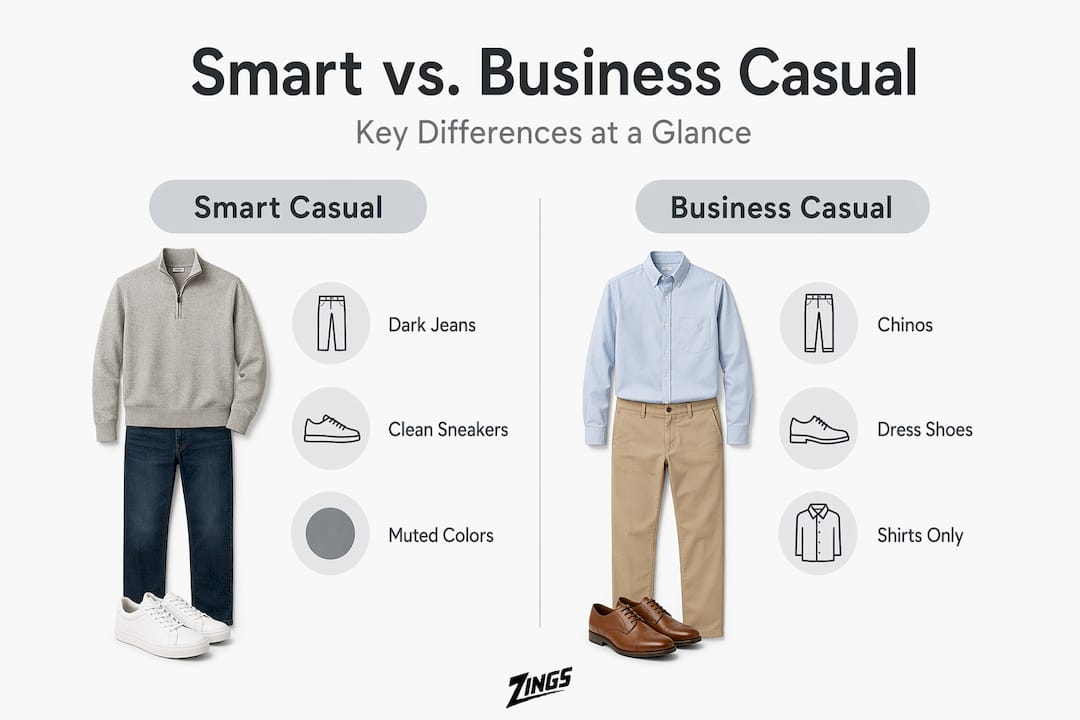
Here is a direct comparison:
| Element | Smart casual | Business casual |
|---|---|---|
| Jeans | Allowed (dark, clean, no distress) | Generally avoided |
| Blazer | Optional but a great upgrade | Often expected |
| Collared shirt | Recommended but not mandatory | Usually required |
| T-shirts | Plain, fitted ones can work | Typically not appropriate |
| Sneakers | Minimalist, clean styles allowed | Usually not appropriate |
| Tailored trousers | Yes | Yes |
| Ties | Not expected or necessary | Sometimes worn |
The practical takeaway is that smart casual gives you more room for relaxed elements, especially at the bottom half of the outfit, while business casual pushes you closer to a full professional look.
Pro Tip: When you are unsure which code applies, default to smart casual with one business-level anchor piece, specifically a blazer or a crisp collared shirt. That one piece will always pull the outfit up if the event turns out to be more formal than expected, and you will still look appropriate if it is not.
Common mistakes people make when navigating these codes:
- Wearing athletic or running sneakers and assuming “clean shoes” covers it
- Picking jeans that are well-fitted but still have fading, rips, or a washed-out color
- Choosing a blazer that does not fit correctly, too long in the sleeve, too boxy in the shoulders, which undermines the entire smart casual look
- Overdoing accessories, especially visible branding or bulky items, which shift the tone toward streetwear rather than smart casual
A well-chosen casual blazer does a lot of heavy lifting. It is the single piece most likely to elevate any smart casual outfit instantly, even when paired with jeans and a plain shirt.
“A blazer over a plain shirt and dark jeans is one of the most reliable smart casual formulas in existence. It communicates effort without appearing overdone.”
Why most people overcomplicate smart casual—and how to keep it simple
Here is an uncomfortable observation: most people do not get smart casual wrong because they lack style knowledge. They get it wrong because they are overthinking it, and that overthinking usually comes from a fear of being visibly out of place.
The real secret to smart casual is simpler than any formula. If your clothes are clean, well-fitted, and you have included at least one elevated piece, you are almost certainly dressed appropriately. The brain spends enormous energy worrying about whether the shoes are too casual or the shirt is too formal, when the people at the event are barely registering those details.
What people actually notice is whether you look comfortable and intentional in what you are wearing. An outfit you are second-guessing will read as awkward regardless of how technically correct it is. Confidence changes how clothing is perceived, and that is not a cliche. It is a visual reality.
There is also a practical argument for keeping your smart casual wardrobe simple and small. A handful of well-chosen, high-quality basics produces more outfit variety than a closet full of trend-driven pieces that do not work together. Two collared shirts, one blazer, two pairs of dark trousers or chinos, and one pair of clean shoes will produce more than a dozen distinct smart casual combinations.
The other thing most style guides will not tell you directly: smart casual is a social contract, not a rulebook. It communicates that you are taking the occasion seriously without demanding a high budget or wardrobe expertise. That intent is what the dress code is really measuring. Focus on the intent, keep the pieces clean and well-fitted, and the details will take care of themselves.
Shop smart casual essentials for every occasion
Embracing a simpler approach makes building your smart casual wardrobe (and shopping for it) much easier. ZINGS 365 carries a range of core pieces specifically suited to smart casual dressing, available at straightforward prices with no need to navigate multiple stores or compromise on variety.
Start with the foundations. A pair of versatile stretch trousers covers both the smart and the casual end of the spectrum. Add spring casual collar shirts for a polished top that works across seasons. Finish with a clean outer layer from the selection of men’s casual jackets that provide structure without formality. These pieces work together and with items already in most wardrobes.
Frequently asked questions
Can I wear jeans for smart casual?
Yes, as long as they are dark, clean, and without distress. Jeans read as smart casual only when they look intentional and neat, not washed out or worn.
Is a T-shirt ever appropriate for smart casual?
A plain, well-fitted T-shirt can work when paired with structured items like a blazer or tailored trousers. Avoid graphic prints, visible logos, and fabrics that have lost their shape.
Are sneakers okay for smart casual?
Minimalist, clean sneakers in neutral colors are acceptable. Athletic styles, chunky trainers, or brightly colored running shoes push the look into casual territory and should be avoided.
How do I dress smart casual for cold weather?
Layer with tailored coats, knit sweaters over collared shirts, or blazers under structured outerwear. Smart casual layering focuses on structured coats or blazers that keep the outfit elevated even in cold conditions.
What’s the main difference between smart casual and business casual?
Smart casual is slightly less formal, allowing clean dark jeans and minimalist sneakers, while business casual focuses on corporate elements and typically avoids denim. Smart casual sits lower on the formality spectrum while still staying clearly above everyday casual wear.
