

TL;DR:
- Personalized shopping uses AI to tailor product recommendations based on your browsing and purchase data. It improves user experience by increasing relevance, boosting conversions, and fostering loyalty. The trend is rapidly replacing traditional shopping methods across online retail platforms.
Personalized shopping is the process by which retailers use data and AI to create a shopping experience tailored to your individual preferences without requiring manual input. This approach, also called ecommerce personalization, is now the standard expectation across online retail. Shoppers who interact with personalized recommendations convert 4.5 times more than those who do not, and 80–81% of consumers prefer brands that offer it. Amazon’s AI shopping assistant Rufus is one of the most visible examples of this shift, using account memory to tailor product suggestions to each shopper over time.
What is personalized shopping and how does it work?
Personalized shopping works by collecting data about you and using AI to turn that data into relevant product suggestions in real time. Every time you browse a product page, add something to your cart, or complete a purchase, the system records that behavior. It then combines that signal with demographic data and past purchase history to build a picture of your preferences.

Personalization is driven by automated data and predictive analysis, which separates it from customization. Customization requires you to manually set preferences, like choosing a size filter or selecting a color. Personalization happens automatically in the background without any action from you.
The core technologies behind this process are machine learning and natural language processing. AI personal shoppers use natural language processing and behavioral analysis to understand your intent rather than just matching keywords. That means when you type “something warm for a weekend hike,” a personalized system interprets the context, not just the words.
Machine learning analyzes large datasets to predict what you are likely to buy next and delivers those recommendations in real time. The more you shop, the more accurate the suggestions become.
- Browsing history tells the system which categories and styles interest you most.
- Purchase behavior reveals your price range, brand preferences, and buying frequency.
- Demographic signals like location and age help the system surface regionally relevant products.
- Account memory stores lifestyle details such as family size or pet ownership to refine future suggestions.
- Contextual signals like time of day or current season adjust recommendations dynamically.
Pro Tip: Update your account profile on any shopping platform you use regularly. Amazon Rufus, for example, lets you edit your stored lifestyle details directly, which improves the accuracy of every recommendation it makes.
What are the benefits of personalized shopping for consumers?
Personalized shopping saves you time. Instead of scrolling through hundreds of irrelevant products, you see items that match your style, size, and budget from the first page. That efficiency is not accidental. It is the direct result of AI filtering out noise before you ever see the results.
Personalized shopping enhances shopper trust by offering relevant deals and suggestions, which leads to increased loyalty and higher average order values. When a platform consistently shows you products you actually want, you stop second-guessing it. That trust compounds over time.
The benefits shoppers experience most consistently include:
- Faster product discovery. Relevant items appear without manual searching.
- Better size and fit accuracy. Systems that know your purchase history can flag sizing issues before you buy.
- More relevant deals. Promotions match your actual interests rather than generic discounts.
- Higher satisfaction. Fewer returns and fewer regret purchases follow from better recommendations.
- Stronger loyalty. Consistent relevance keeps you coming back to the same platform.
“Consumers expect businesses to meet their specific needs with personalization comparable to close relationships, with 73% expecting it today.”
That expectation is not a trend. It is the new baseline. Brands that fail to meet it lose customers to those that do. For shoppers, this means you now have real leverage. If a platform does not know your preferences after several purchases, it is not doing its job.
Knowing how to shop trendy clothing without wasting money becomes much easier when the platform surfaces the right options for your taste and budget from the start.
Personalized shopping vs. traditional shopping: what changes?
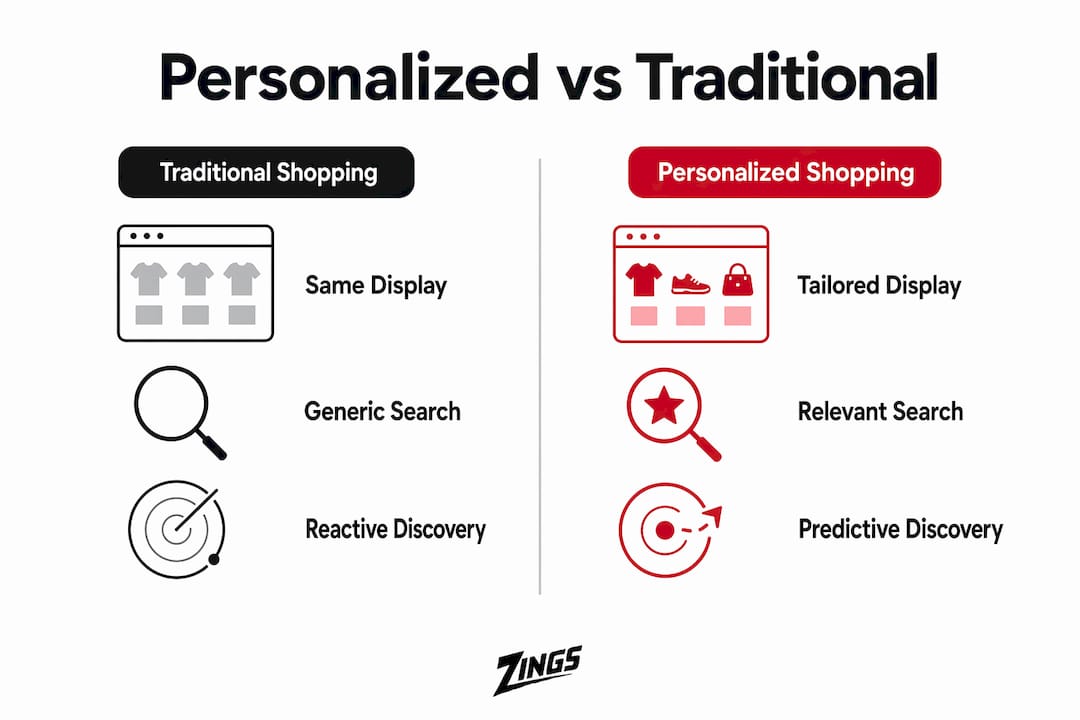
Traditional shopping follows a one-size-fits-all model. Every shopper sees the same homepage, the same featured products, and the same promotions. The burden falls on you to search, filter, and evaluate. Personalized shopping flips that dynamic entirely.
| Feature | Traditional shopping | Personalized shopping |
|---|---|---|
| Product display | Same for all shoppers | Tailored to individual behavior |
| Search results | Keyword-based only | Intent-based with context |
| Promotions | Generic discounts | Deals matched to your interests |
| Effort required | High (manual filtering) | Low (AI does the filtering) |
| Accuracy over time | Static | Improves with each interaction |
| Loyalty building | Transactional | Relationship-based |
The practical difference shows up most clearly in search. A traditional search for “blue shirt” returns every blue shirt in the catalog. A personalized search for the same term returns blue shirts in your size, at your price point, from brands you have bought before. The query is identical. The experience is not.
Personalization is a necessity to maintain engagement and loyalty. Brands that rely on static, non-personalized experiences see lower engagement and higher churn. For shoppers, this means the gap between a personalized and a non-personalized platform is now wide enough to feel immediately.
Predictive recommendations also change how you discover new products. Traditional retail is reactive. You search for what you already know you want. Personalized retail is predictive. It surfaces products you did not know you wanted but are highly likely to buy. That shift from reactive to predictive is the defining feature of modern ecommerce personalization.
How to get the most out of personalized shopping apps and websites
Not every platform that claims to offer personalization actually delivers it. Genuine personalization adapts to your behavior over time. Generic marketing just uses your first name in an email. Knowing the difference helps you choose platforms worth your time.
Signs of true personalization include:
- Recommendations that change after each purchase or browsing session.
- Search results that reflect your size, price range, and past preferences.
- Promotions tied to categories you have actually browsed.
- An AI assistant that remembers context from earlier in the same conversation.
- Account settings where you can view and edit stored preferences.
Amazon Rufus stores shopper lifestyle information such as family details and pet ownership to tailor recommendations over time. Users can edit this stored data directly, which makes the system more accurate. That level of transparency is a strong indicator of genuine personalization.
When using any AI shopping assistant, give it specific context. Instead of typing “jacket,” type “casual jacket for cool weather, under $80, slim fit.” AI personal shoppers interpret intent rather than just matching keywords, so the more context you provide, the better the result.
Privacy is a real consideration. Every personalized shopping app stores behavioral data. Check the platform’s privacy settings to see what is collected and whether you can delete or limit it. Most reputable platforms give you that control.
Pro Tip: Use price and style filters alongside AI recommendations. Filters narrow the pool, and AI ranks within that pool. The combination produces faster, more accurate results than either tool alone. For fashion-specific sizing guidance, smarter sizing techniques can further reduce returns.
For shoppers building a wardrobe with intention, reviewing a trendy clothing selection workflow alongside personalized recommendations helps you stay consistent with your style goals rather than buying reactively.
Key Takeaways
Personalized shopping works because AI continuously learns from your behavior and delivers more accurate recommendations with every interaction you have on the platform.
| Point | Details |
|---|---|
| Definition is clear | Personalized shopping is automated, data-driven tailoring. It requires no manual input from you. |
| Conversion impact is real | Shoppers who engage with personalized recommendations convert 4.5 times more than those who do not. |
| Consumer expectation is high | 73% of consumers now expect personalized experiences from every brand they shop with. |
| AI tools improve with use | Platforms like Amazon Rufus store and refine lifestyle data over time for better suggestions. |
| Engagement beats generic retail | Brands without real-time personalization lose customers to those that offer it consistently. |
Personalization is moving faster than most shoppers realize
The pace of change in AI-driven shopping is genuinely surprising, even to people who follow it closely. A year ago, account memory in shopping assistants was a novelty. Now it is a standard feature on major platforms, and the gap between what AI knows about your preferences and what you consciously tell it is closing fast.
My honest view is that most shoppers are underusing the tools already available to them. They interact with AI assistants the same way they used keyword search in 2010. They type short, vague queries and accept whatever comes back. That approach wastes the actual capability of these systems. The shoppers who get the most value are the ones who treat AI assistants like a knowledgeable friend. They give context, correct bad suggestions, and update their stored preferences regularly.
The privacy side deserves more attention than it gets. Cross-platform personalization is coming. That means your behavior on one platform will eventually inform recommendations on another. That is genuinely useful, but it also means your data footprint is growing in ways that are not always visible. Staying informed about what each platform stores and how to edit or delete it is not paranoia. It is basic digital literacy.
The shoppers who will benefit most from personalization advances are the ones who stay active participants rather than passive recipients. Update your preferences. Correct wrong recommendations. Use the tools that give you control. The technology is getting better fast. The question is whether you are using it well.
— TONY
Personalized style picks at Zings365
Zings365 carries a catalog built for shoppers who know what they want and want to find it fast. The men’s collection includes pieces that reward a personalized approach to shopping.

The Fall men’s British casual fashion shirt is a strong example of a product that fits naturally into a curated wardrobe. For outerwear, the Men’s Casual Jacket offers a versatile option across seasons. Both pieces reflect the kind of specific, style-conscious selection that personalized shopping is designed to surface. Browse the full Zings365 collection to find pieces that match your actual preferences, not just what is trending broadly.
FAQ
What is personalized shopping in simple terms?
Personalized shopping is when a retailer uses your browsing history, purchase behavior, and preferences to show you products tailored specifically to you. It happens automatically, without you needing to set anything up manually.
How does personalized shopping work technically?
Machine learning models analyze your browsing patterns, past purchases, and demographic signals to predict what you want next. AI tools like natural language processing also interpret the intent behind your search queries, not just the keywords.
What is the difference between personalization and customization?
Personalization is automated. The system adapts to your behavior without input from you. Customization is manual. You actively choose settings, filters, or preferences yourself.
What is a personalized shopping app?
A personalized shopping app uses AI to tailor product recommendations, search results, and promotions to your individual behavior. Amazon’s Rufus is a well-known example that stores lifestyle details to refine suggestions over time.
Why choose personalized shopping over traditional browsing?
Personalized shopping reduces the time you spend searching and increases the accuracy of what you find. Shoppers who engage with personalized recommendations convert 4.5 times more than those who browse without them.
