

TL;DR:
- Fashion terminology evolves with seasons and culture, influencing how you shop and communicate about clothes. Understanding silhouettes, fabrics, construction, fit, and sustainability terms enables you to read descriptions confidently and avoid greenwashing. Organizing vocabulary into categories mirrors industry workflows, fostering practical comprehension and application.
Fashion terminology explained correctly can change how you shop, create, and talk about clothes. Most people pick up words like “A-line” or “bias cut” from magazines and assume they understand them, but fashion terminology evolves with every season, cultural shift, and industry development. A word that meant one thing in 1960 carries different weight today. This guide covers silhouettes, fabrics, construction, fit, and sustainability vocabulary so you can read a product description, follow a design conversation, or build your own style with real confidence.
Table of Contents
- Key takeaways
- Fashion terminology explained: silhouettes and garment features
- Fabric and textile terms you need to know
- Garment construction and production language
- Measurement and fit terminology
- Sustainability vocabulary in modern fashion
- My take on learning this vocabulary
- Dress the part with Zings365
- FAQ
Key takeaways
| Point | Details |
|---|---|
| Terminology changes over time | Fashion terms shift with culture and season, so context always matters when interpreting them. |
| Silhouettes and fit have distinct vocab | Terms like A-line, empire waist, and slim fit each describe specific garment structures you can learn to recognize. |
| Fabric language affects real decisions | Understanding bias cut, jacquard, and intarsia helps you evaluate quality and predict how a garment will wear. |
| Tech packs are more than spec sheets | A tech pack includes construction details, colorways, and quality checks that a spec sheet alone does not cover. |
| Sustainability terms require scrutiny | Words like circularity and biodegradable are often used loosely, so knowing their precise meanings protects you from greenwashing. |
Fashion terminology explained: silhouettes and garment features
Every garment starts with a silhouette. That is the overall shape you see when you look at a piece of clothing from a distance, before any color or fabric detail registers. Fashion vocabulary covers silhouettes, fit, sewing methods, fabrics, and production stages, and silhouettes are where most beginners start.
The A-line silhouette fits close at the top and gradually widens toward the hem, resembling the letter A. It works across skirts, dresses, and even some coat styles. The empire waist places the seam just below the bust, creating a high-waist visual that elongates the leg line. Both terms come from mid-20th century fashion design and remain widely used today in retail descriptions.
Beyond silhouettes, garment features add structural detail:
- Dart: A folded, stitched taper sewn into fabric to give a flat piece of material a three-dimensional shape, most common around the bust and waist.
- Pleat: A fold of fabric stitched at one end and left loose at the other to add volume or movement. Box pleats face outward; knife pleats all face the same direction.
- Godet: A triangular or curved panel inserted into a seam to add flare at the hem without widening the entire garment.
- Gusset: A small piece of fabric inserted into a seam at a point of stress, such as the underarm or crotch, to allow free movement.
Pro Tip: When you read a product description, scan for these structural terms. A trouser listed as having “forward pleats” will sit and move very differently from a flat-front trouser, even in the same size.
Understanding these terms is not just academic. When you know what a godet is, you can identify why one skirt flows and another does not, or explain to a tailor exactly what you want. That is what clear fashion communication is built on.
Fabric and textile terms you need to know
Fabric vocabulary tells you what a garment is made from, how it was constructed at the textile level, and how it will feel and move on your body. These terms show up constantly in product descriptions, care labels, and design briefs.
Some key textile terms:
- Denim: A sturdy cotton twill fabric originally woven in Nimes, France. The diagonal rib of the weave is its defining characteristic. For a deeper look at how denim terms apply to real clothing choices, the denim style guide at Zings365 is worth reading.
- Jacquard: A fabric woven on a Jacquard loom, producing intricate patterns directly into the weave rather than printed on top. The pattern is structural, not surface decoration.
- Appliqué: A technique where a separate piece of fabric is stitched onto a base fabric to create a design or texture. Common in streetwear and sportswear.
- Intarsia: A knitting technique that creates multi-color patterns within the fabric itself. Each color section uses its own yarn, resulting in a flat, smooth surface unlike stranded knitting. Textile techniques like appliqué and intarsia have distinct origins and production methods that affect both cost and appearance.
The bias cut deserves special attention. Cutting fabric diagonally across the grain creates natural stretch and a fluid drape that straight-cut fabric cannot achieve. Designer Madeleine Vionnet popularized it in the 1930s for evening gowns that clung to the body without boning or structure. The trade-off is cost: bias cut requires roughly 1.5 times more fabric than a straight cut, which explains why bias-cut garments typically price higher.
Sustainability vocabulary also lives in this category. Terms like organic cotton, recycled polyester, and TENCEL reference both fiber origin and production method. If you want to understand how clothing materials connect to sustainability, that resource breaks it down clearly for everyday shoppers.

Garment construction and production language
This is where fashion jargon gets genuinely technical, and where misunderstanding a single term can cause a production run to go wrong.
Construction vocabulary describes how pieces of fabric are joined and finished:
- Seam: The line where two pieces of fabric are stitched together.
- Seam allowance: The strip of fabric between the cut edge and the seam line. Typically 1.5 cm in standard garment production, but this varies by factory and garment type.
- Placket: The strip of fabric that reinforces a button or zipper opening. The front of a dress shirt is a placket.
- Flat-felled seam: A seam where one allowance is folded over the other and stitched down flat. You see this on the inner leg seam of quality jeans. It is strong, clean on both sides, and resistant to fraying.
- Overlock: A stitch that simultaneously sews and finishes a seam edge to prevent fraying. Sometimes called a serged seam.
Production documents are where these terms live professionally. A tech pack is a complete technical document that gives manufacturers everything they need to produce a garment accurately. It goes far beyond a spec sheet.
| Component | Tech pack | Spec sheet |
|---|---|---|
| Garment measurements | Yes, with tolerances | Yes |
| Construction details | Yes, with diagrams | Sometimes |
| Colorways and trims | Yes, full breakdown | Rarely |
| Label and packaging specs | Yes | No |
| Quality control checkpoints | Yes | No |
| Artwork and print placement | Yes | No |
A tech pack is the single source of truth for garment production, covering construction, colorways, labels, and quality checks. A spec sheet is a subset of that, not a replacement.
Pro Tip: If you are a fashion student creating your first tech pack, treat the spec sheet as the measurements page and build everything else around it. Students who confuse the two often submit incomplete documents that would cause real production problems.
Measurement and fit terminology
Fit is the most personal dimension of fashion, and its vocabulary is more precise than most people realize. Measurement terms and fit types like waist circumference, neck drop, oversized, and slim are core categories in professional fashion vocabulary.
Here is what those terms actually mean in practice:
- Waist circumference: The horizontal measurement around the narrowest part of the torso. In pattern drafting, this is a fixed starting point. In retail, it appears on size charts.
- Neck drop: The vertical distance from the shoulder line to the lowest point of a neckline. A deeper neck drop means a lower neckline. Knowing this term helps you predict how a top will sit before you buy it.
- Slim fit: A cut that follows the body with minimal ease. “Ease” is the difference between your body measurement and the garment measurement, and slim fit uses very little of it.
- Relaxed fit: Adds significant ease throughout, creating room for movement and layering without a tailored appearance.
- Oversized: A deliberate design choice to cut a garment much larger than the body, often used to create a specific aesthetic rather than simply accommodate a larger size.
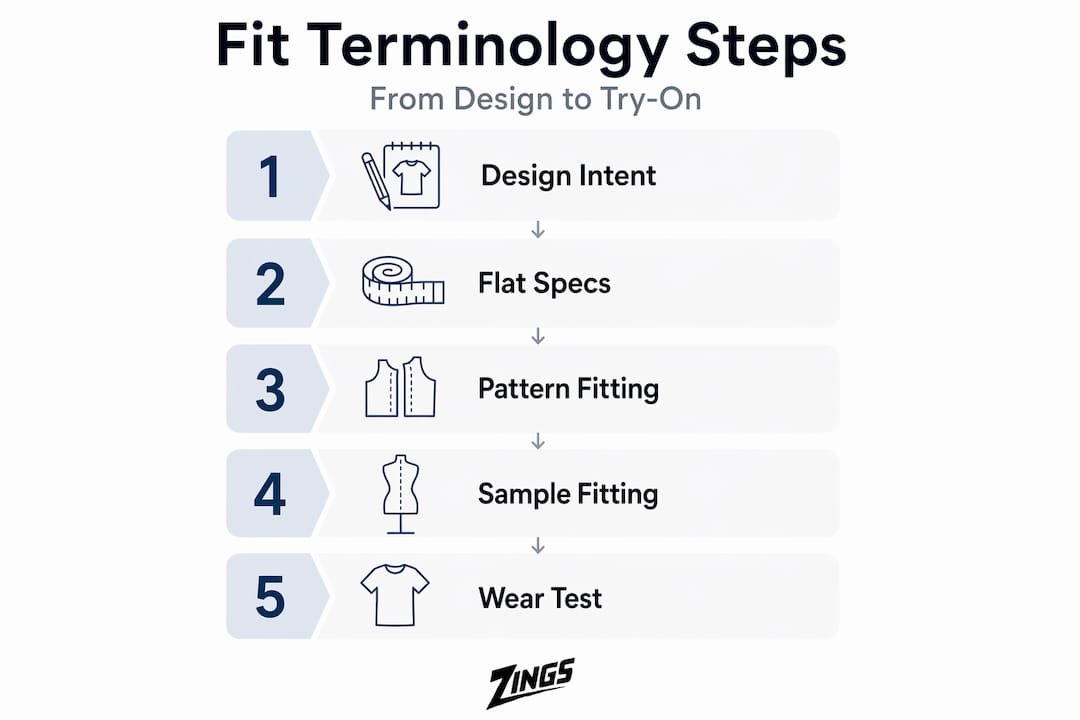
Fit intent notes are used by designers to communicate the desired relationship between the garment and the body before a sample is produced. A note that says “relaxed through the seat and thigh, tapered below the knee” gives a factory a clear target to hit. When you understand fit language, reading a sizing guide for online shopping becomes a much faster and more accurate process.
Sustainability vocabulary in modern fashion
Sustainability has its own growing lexicon, and the language is contested territory. Standardized sustainability terminology supports education and policy development, but it also has to work against years of vague marketing.
Core terms to know:
- Circularity: A system where garments are designed to be repaired, resold, or recycled at end of life rather than sent to landfill. Circular fashion requires thinking about the end of a garment’s life from the moment it is designed.
- Upcycling: Transforming discarded materials into something of higher value. Different from recycling, which typically breaks materials down before rebuilding them.
- Fair trade: A certification and trade standard that requires fair wages and safe working conditions for producers. It applies to both fiber growing and garment manufacturing.
- Biodegradable: A material that breaks down naturally through biological processes. Not all natural fibers are fully biodegradable once dyed or treated with synthetic finishes.
- Carbon footprint: The total greenhouse gas emissions linked to a garment’s production, transportation, and disposal.
Sustainability terms in fashion marketing are often legally non-exclusive, meaning brands can use them without meeting a defined standard. Knowing the precise definitions gives you the ability to ask better questions and make more informed purchases. If you want to see how affordable fashion can still be responsible, that connection is worth exploring.
My take on learning this vocabulary
I have spent years watching fashion students and enthusiasts try to pick up industry vocabulary by memorizing definitions one term at a time, and it rarely sticks that way. What actually works is organizing the vocabulary into the categories that match how the industry thinks: silhouettes and design, fabrics and textiles, construction, measurement, and sustainability. When you study terms in that structure, you are not just memorizing words. You are learning the workflow.
The contrarian view I will offer is this: most people worry too much about learning jargon and not enough about understanding why each term exists. A bias cut is not just a vocabulary word. It is a decision with cost consequences and aesthetic outcomes. A tech pack is not jargon. It is a system for removing ambiguity from a conversation that would otherwise happen across language barriers between a designer in one country and a factory in another.
What I have found is that readers who approach fashion vocabulary as a practical toolkit, rather than a test to pass, retain it faster and apply it with more confidence. Read product descriptions actively. When you see a term you do not recognize, trace it back to a construction method, a fabric origin, or a measurement system. That habit builds real fluency faster than any glossary alone.
— TONY
Dress the part with Zings365
Now that you can read a garment description with clarity, put that knowledge to work while shopping. Zings365 carries a well-described catalog of casual and fashionable pieces where terms like slim, stretch, and relaxed fit show up in real product context.

The casual stretch trousers are a solid example: the product name alone uses “slim,” “casual,” “stretch,” and “straight” as genuine descriptors, not marketing filler. Browse the satin lined beanie and you will spot textile terminology applied to accessories. If outerwear is your focus, the men’s casual jacket gives you a practical example of construction terms in action. Zings365 updates its catalog regularly with new arrivals, so there is always something new to analyze and wear.
FAQ
What does fashion terminology mean?
Fashion terminology is the shared vocabulary used to describe garment design, fit, fabrics, and production processes. It covers everything from silhouette names to construction techniques and sustainability concepts.
What is the difference between a tech pack and a spec sheet?
A spec sheet lists garment measurements and basic construction notes. A tech pack is a full production document that also includes colorways, trims, labels, artwork placement, and quality control checkpoints.
What does bias cut mean in fashion?
Bias cut means cutting fabric diagonally across the grain, which creates natural stretch and a fluid drape. It requires about 1.5 times more fabric than a straight cut, raising production costs.
Why does fit terminology matter when shopping online?
Fit terms like slim, relaxed, and oversized describe specific relationships between the garment and the body. Understanding them helps you predict how a piece will look and move before it arrives.
What is greenwashing in fashion terminology?
Greenwashing happens when brands use sustainability terms like biodegradable or circular without meeting defined standards. Knowing the precise definitions of these terms helps you evaluate claims more accurately.
